Sunday, August 29, 2010

Modern Icons Chapter 4: September Vogue


Every year I perform a ritual: receiving and absorbing the enormous pillow that is the September issue of Vogue Magazine. This year's book is more than 700 pages. Every page contains an image of the perfect woman, as imagined by the straight women and gay men of Manhattan Island.  Each picture is a triumph of our collective imagination, soaring above bothersome reality. The women in these photographs lend their bodies to a highly artificial expression of an ideal. They are not human, any more than was the colossal Athena Nike who stood inside the Parthenon.  

The goddess above is an apt introduction. She exists in an instant of supreme connivance; every particle of her is bended into a curving, purple flight to heaven. This photograph was staged by an army of artists, who ran off camera the instant before the shutter clicked. They ran back the next instant, to catch the fragile moment before it disintegrated. You cannot look like this. No one does. Even the model does not look like this. The dubious advertising angle is this: if you buy something, you might get a tiny piece of her grandeur.


In this escapist encyclopedia, restraint is the only taboo. Our ideal female should fly so far from reality that she ceases to breathe. Ultimately, what is sold is this unencumbered spirit girl. Clothes, shoes, handbags are tokens. Women don't want to dress like her, ultimately, but to BE her. For this reason, some designers attempt to sell clothes by presenting teenage girls naked. The circle of promised fulfillment makes me dizzy! "You can have your 19-year-old body again, underneath our clothes, which we won't bother to show you because they don't matter."


Not only can you spend your days naked, you can sit safely with lion cubs in your lap and an expensive handbag. 


The sheer precision of this composition awes me. The allignment of the model, her dress and the swirling arrows is so difficult as to be nearly impossible. A moon landing may enjoy a wider margin of error than this photograph.  


Girls, if you can muster the courage to put on this outfit [above], there's a big payoff. Wherever you go, everyone else in the room will become invisible. If the President arrives at the party, followed by an alien spaceship, no one will remember. All they will talk about afterward will be YOU.


Women in skirts rule all others. Period. 


I don't know where to begin here, so I won't.


The Beautiful People. You want to sit in that vacant chair. Admit it.


While being ravished by her Prince Charming, our girl bravely checks with the photographer: "Does my hair look good?"

I suspect September Vogue is on the way out, at least in paper form. The management has put some excellent content on the internet in recent years, but so far it's still far inferior to their printed pages. Meanwhile, the distribution of the magazine has deteriorated. The current issue used to appear in the checkout line of every medium-sized grocery store, but no more.  Now I must walk to a fairly large magazine section before I find a copy. I will miss it, if it goes.


Saturday, July 24, 2010

1000 Incidents of Beauty Every Day


In some of the heart’s business there is really no net gain.
Richard Ford, The Sportswriter


[Zeus] swore to be revenged, on mankind first and then on mankind's friend. He
made a great evil for men, a sweet and lovely thing to look upon, in the
likeness of a shy maiden, and all the gods gave her gifts, silvery raiment and
a broidered veil, a wonder to behold, and bright garlands of blooming flowers
and a crown of gold--great beauty shone out from it. ...When this beautiful
disaster had been made, Zeus brought her out and wonder took hold of gods and
men when they beheld her. From her, the first woman, comes the race of women,
who are an evil to men, with a nature to do evil.
Edith Hamilton, Mythology


It is our light, not our darkness, that most frightens us.—Marianne Williamson


I felt that at some time or other I had passed through the valley of diamonds, but I could convince no one—not even myself, when I looked at them more closely,—that the specimens I had brought back were not mere pieces of gravel.—Carl Jung, Memories, Dreams & Reflections


The train hurtled through towns where cars waited at the crossing and a collie peered down its long nose at an alley cat and the sun found over there a single small window to dazzle—just as I imagined God, if He existed, might find in a whole crowd only one soul turned at the right angle to reflect His glory. —Edmund White, The Beautiful Room is Empty


To get away from the tragedy—and the talk—some of his friends had moved to places like Phoenix and Charlottesville, but Michael couldn’t see the point of it. The worst of times in San Francisco was still better than the best of times anywhere else.

There was beauty here and conspicuous bravery and civilized straight people who were doing their best to help. It was also his home, when all was said and done. He loved this place with a deep and unreasoning passion; the choice was no longer his. —Armistead Maupin, Significant Others


Sunday, July 18, 2010

The Tyranny of Ideas


We often get riled up over issues and causes that are not our own, that we can do nothing whatever about. This unfortunate tendency is portrayed with refreshing clarity in Susan Wise Bauer's book, The History of the Medieval World: From the Conversion of Constantine to the First Crusade. During the medieval period, four of the world's five major religions codified their doctrines. We know a lot about how this happened, but few people bother to find out about it. 


I was raised to consider religious ideas on their own, as if they were the result of people wondering about life, suggesting answers. Medieval history proves that religion did not develop this way. All the major religions owe their existence to rulers, men who designed or re-tooled the doctrines to preserve the rulers' power. We only have these ideas to argue about because they once served someone's earthly ambitions.

I find this fascinating. It's possible for people to burn with passion, thinking they are caring for their own needs, when in fact they are serving someone else's desire for power. And the person served may have died several centuries ago, but the practice survived. The ensuing arguments sound especially futile, from a distance. I like this example from Bauer's book:


[During the Byzantine Empire] Arguments about the Arian take on the divinity of Christ, as opposed to the Nicene understanding, had spread to the lowest levels of society. 

"Everywhere throughout the city is full of such things," complained bishop Gregory of Nyssa, in a sermon preached at Constantinople, "the alleys, the squares, the thoroughfares, the residential quarters; among cloak salesmen, those in charge of moneychanging tables, those who sell us our food. For if you ask about change, they philosophise to you about the Begotten and the Unbegotten. And if you ask about the price of bread, the reply is, 'The Father is greater, and the Son is subject to him.' If you say, 'Is the bath ready?', they declare the Son has his being from the non-existent. I am not sure what this evil should be called—inflammation of the brain or madness or some sort of epidemic disease which contrives the derangement of reasoning."


This slice of urban life is familiar to me. In my beloved city of San Francisco, it is impossible to talk to anyone or transact any business without the requisite professions of faith. During the early years of the 21st century, an exchange at Starbucks went like this:

"Good morning, I hate George Bush."
"Yes, it would be a good morning, if only he weren't the president, what can I get you?"
"Bush stole the election. One decaf latte, please. Bush should be impeached."
"That'll be $2.50. Bush should be castrated."
"Here you go. Try to endure, until we kill Bush."
"You too, and don't even ask me about Reagan because we'll never recover from the destruction he wrought."


Ideas don't come with labels. We don't know where they came from unless we trouble ourselves to investigate. It's easier to unpack them when you get older, just because you've seen them come and go over time. The young are easily knocked down without warning. Did someone ask you to sign a petition today, to save the world? How old were they? 


Several years ago, I read an essay by an alert young woman who wasn't sure if she wanted a boyfriend or not. She assigned a new name to herself and others like her, Quirkyalone, and proceeded to sing an entertaining song about single life. I enjoyed the article, but I was somewhat embarrassed for her. This girl wrote as if she were the first person ever troubled by mixed feelings about connections with other people. Apparently, she was in good company, as she appeared on television interviews and published a book on the subject. Inspired by her audacity, I marched down to the patent office and applied for a service mark on my invention, which I call The Wheel.

Each of us is fascinated by him- or herself, which is only natural. We tend to see the whole world as if it were focused on us alone—quirky or not. If we don't try to get an outside, historical perspective once in a while, it's easy to think we're acting independently, when in fact we are playing a script we dug out of a dumpster.


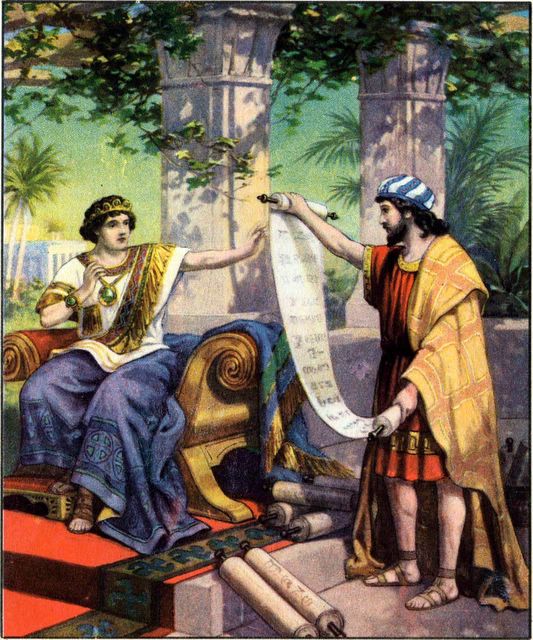
What we find in that dumpster can be planted, in the expectation we will find it. In ancient Israel, King Josiah had trouble leading the stubborn Hebrews. He sent his priests and officials into the depths of the Temple, to perform an exhaustive inventory. In a stroke of good luck, they uncovered the Book of Deuteronomy, God's own law book. Deuteronomy just happened to endorse every measure of reform Josiah wanted. In China, Emperor Wang Mang needed a unifying inspiration for his people, and the ideas they most valued were those of Confucius. Unfortunately, a previous emperor had ordered all Confucian writing burnt. Wang Mang sent men to dig under the house Confucius had lived in. Imagine their rejoicing when they found un-burnt books by Confucius! And do you think those books contained anything in opposition to Wang Mang?   


I'm not sure we can escape any of this. We can be aware of it, and gain instruction from the drama of human ideas, struggling to survive. Evolutionary biologist Richard Dawkins explored this idea many years ago in his book, The Selfish Gene. He coined the term meme to stand for an idea that has characteristics favorable to its survival and reproduction. In Dawkins's conception, the meme lives like a virus. It doesn't have an agenda; it doesn't care about reproducing, but does so by the accident of being well-fitted [Malcolm Gladwell calls this property stickiness]. It does not care about the long-term health or well-being of its host. Dawkins doesn't take it this far, but I observe that because of their nature, the properties of memes can destroy those infected, just as viruses can destroy their host organisms. 


The ending of Ms. Bauer's book sums up Emperor Constantine's use of—and remaking of—Christianity to serve his ends:  
The founding of the military orders [in the 12th century] was the closing act in the drama begun by Constantine at the Milvian Bridge. Marching into Rome under the banner of the cross, he had taken a powerful and mysterious theology and bent it to his own purposes. It had promised unity. He needed unification. It had promised ultimate victory. He needed earthly victory at once. It had promised an identity that transcended nationality and language. He had needed to overcome nationalism. Most of all, he needed to convince his soldiers, the people of Rome, and the enemies who threatened him, that he was driven by something higher and more noble than simple ambition. Probably he needed to convince himself, as well. Christianity gave Constantine freedom from guilt over his conquests, at the same time that it lent him the zeal he needed to pursue them. Seven hundred years later, the military orders did exactly the same things for the men who joined them, and gave them a rule, to spell out precisely what they would gain. That marriage of spiritual gain and political power would shape the next five centuries, and the painful and protracted divorce between the two, the centuries after that. 


Saturday, July 3, 2010

The Way Forward

These times of change suit big enterprises. — Tacitus, Histories, 105 CE


We live in disturbing times. All around us, our support systems appear to break down. Banks fail, governments falter. Values we held to be universal are challenged or ignored. Our unease over these events is made more painful by news outlets that relay them in the most alarming terms. 


Despite our fear, we are fortunate to live in troubled times. Change brings opportunity, where stability does not. The Italian Renaissance produced giant leaps in human achievement, and it cannot be an accident that these leaps took place amid dizzying political and social change. Life during the Renaissance was dangerous, much more so than in our time. In that era, if you whispered any disagreement with the governor of your city, you risked immediate execution, by horrible means. If, on the other hand, you were too courteous and obedient, you could easily be executed the following week, when the governor was murdered and replaced.  

Brother Savonarola suggested that the Church get back to its roots. In this picture, the Church gently corrected Savonarola [center left, in flames].

People with power lost it. People formerly powerless gained it, and the cycle repeated. Because of this dispersion of power, different ideas and tastes were fulfilled in art, science and literature. More voices were heard, and the level of discourse rose through expanded references. 

No matter how much we may want to run away from the present, be assured that someone else will recognize the opportunities. Right now nimble minds are opening new businesses, retooling old ones, or replacing their old identities, becoming new people. 


Author Robert Greene tackles this subject in an e-Book, containing material from his public lectures. His title is The Descent of Power—Thoughts on The Great Transformation and How to Master It. 


Greene says: What is really changing in the world is not technology, or the globalization of capital, but the relationships between people—relationships that were once hierarchical and based on the force of authority. This has been radically flattened. What matters most now are the connections between people, the interdependencies and networks that can be formed and the unimpeded flow of information. Any kind of obstruction to that flow will be seen as something from the past, someone or some group trying to halt the course of an historic fatality. 


Take heart, fellow soldiers. Seize this moment. As Greene says in his conclusion, it is likely we will look back on this time as one of enormous opportunity. Let's not miss a minute of it. 

Sunday, May 30, 2010

Modern Icons Chapter 3: Japanese Magazine Ads


My wife reads women's magazines published in Japan. These publications are superior in every way to Vogue, Cosmopolitan, and Marie Clare. They are generally larger and cover more subjects than their American counterparts. One issue contained articles on hairstyle, vacation destinations, the life of an expatriate Japanese woman in Paris, interior decorating and cooking. I can't compare the quality of writing, but the most important pages for me are the ads, and the ads in the Japanese magazines blow me away. 

I can't find out if these Ralph Lauren ads were only published in Japan, or duplicated in other markets. Maybe that's not important. Again I am captivated by these images, because they clearly present an ideal to be reached for, an image of life as it could be and should be.


The little boy's heartbreaking good looks are only the introduction. He's gone GQ to the extent of wearing a wrist watch and a gold safety pin in his collar. He's at an age where boys can outgrow their clothes in a few weeks, and boys often destroy their garments even sooner. Consequently, parents rarely buy fancy clothes for little boys; it's an inefficient use of money. That's how normal parents [like me] think. This ad wants to turn that around. It says to us, "You aren't just a parent. You are the head of an important dynasty, and you have an image to keep up. Go ahead, dress him up, you can afford it! The impression he makes will be worth it, even if the soft puppy pees in his lap."


Japanese ideals of feminine beauty include big eyes, and the bigger the better. 


The Japanese ideal relaxes a bit on mixed-race or non-Japanese faces and figures. I have never seen a model like this one in American ads. Her chest, hips and hands are wider than the pencil-thin models in America. I don't prefer one type over another. Recognizing the pattern is the interesting, difficult part. Cultural currents affect us unconsciously. Often, we can't perceive them at all unless we see something different, by accident. 


Sunday, May 16, 2010

Max's Camera Work 2

My son Max is six years old now. He got his own camera for his birthday. You can see his earlier photos here.


I looked into her eyes, the most intense eyes I’d ever seen. When she shut them at the end of the day it was like the end of an era.—Scott Spencer, Preservation Hall


I couldn’t stop from thinking of the other life I’d once led. Grief is a most peculiar thing; we’re so helpless in the face of it. It’s like a window that will simply open of its own accord. The room grows cold, and we can do nothing but shiver. But it opens a little less each time, and a little less; and one day we wonder what has become of it.—Arthur Golden, Memoirs of a Geisha


Just as every lover at some level believes that he or she makes love as it’s made nowhere else on the planet, so every artist clings for dear life to the illusion that the art he or she produces is vital, necessary, unique. Aesthetic elitism, sexual snobbery; these are not the reprehensible attitudes that our culture makes them out to be. They’re the efforts of the individual to secure a small space of privacy within the prevailing din. All people should be elitists — and keep it to themselves. [Books In Bed]
— Jonathan Franzen, How To Be Alone: Essays


I too walked the streets of Manhattan island, and bathed in the waters around it,
I too felt the curious abrupt questionings stir within me.—Walt Whitman


If despair even [in youth] is terrible, what must it be in age, when the years rush past with a growing pallor and through the dusk we begin to see the stars of eternity?—Victor Hugo, Les Miserables


Max's camera can add Disney characters to his frame. Normally I don't like this, but in this shot, it works well.


Saturday, May 8, 2010

Modern Icons Chapter 2: Schwinn Bicycle Catalog, 1972

People wish for better lives than they have. Our aspirations follow the direction of our culture's ideals. These aspirations and ideals are presented most powerfully and beautifully in advertising. A compelling ad injects feeling into us: I want to be that! Ads triumph through design and execution. No part of an ad photo is an accident, it all has to contribute to the desired effect. Advertising agencies ensure the quality of their work by throwing the best minds at an image, and a unbelievably large amount of money, more than any artist could afford.


This beautiful photo of a girl with her bicycle illustrates what I'm talking about. If you just glance at it, it looks like a photo you could take yourself, on an afternoon bike ride. However, this impression is entirely false. This photograph is the result of precise staging. It required big equipment and several technicians working together. A large artificial light was placed to our left, so that the girl and the bicycle would not appear in shadow, the sun being behind her head. We can only imagine the effort required to coax the ducks close enough to the bike so their cute parts were photographed, but not their duck-droppings, which surely existed off to the right. Of course, the girl herself had to be beautiful, hair just so, and the bike shiny. Again, we don't want the bicycle for itself, but because it's close to her, in a prettier world.


These images come from a Schwinn catalog, published in 1972. You can see the whole thing here. The photographs were shot in southern California. It looks heavenly, doesn't it? When I saw this catalog, I was living in Texas. If I'd had a choice, I would have packed a car and moved right away. Life in California—drenched in sunlight, populated with healthy, happy people—is the big product here. If we can't move, maybe we'll get a little of this magic if we buy a Schwinn bike.


What single girl wouldn't want to jump into this picture?


This is my favorite page. It's another vision of Heaven and every inch of it is set precisely to convey the message: If you're old, you can stay healthy and pursue romance on this adult-sized tricycle. I'm beginning to look like these people now, so it may be time for me to buy one. 

Sunday, May 2, 2010

Modern Icons Chapter 1: How We Got Here

I like to look at idealized images of people. Advertising makes the biggest impact on me, for reasons I'll write about later. Before I appreciate recent images, I'll set down some notes about how this part of human culture developed.

The sculpture above is known as The Venus of Willendorf. We think it was made between twenty and forty thousand years BCE. This figure may represent an ideal in the mind of its sculptor, but to us in the 21st Century, she looks shockingly familiar. This is woman in a state of nature: female, not feminine. Her body is soft and liquid, an element in the warm, primordial swamp. Femininity comes later. It is a human projection, a rebellion against the female in nature.

Professor Camille Paglia details the tensions between humans, nature and culture in her magnum opus, Sexual Personae. Some modern people grow weary of modernity, and desire a life closer to that of our distant ancestors. They are greatly deluded. If you have ever worn eyeglasses or undergone dental work, you do not qualify for the life of a hunter-gatherer. All culture—almost all human activity—is a direct war on nature. Art is a lie, a denial of who we are, a plot to escape from our true place, under the heel of cruel Earth. Instead of telling the truth, art presents humans as they would like to be.


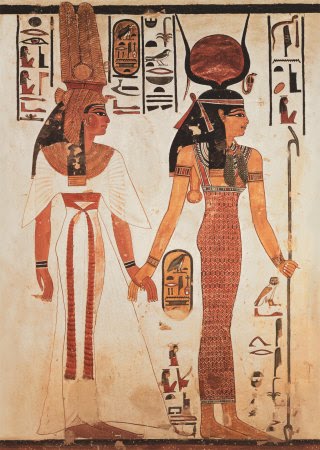
Our Venus has no place in this Egyptian wall painting. These figures are feminine, not female. Every piece of them is artificial, beginning with their iconic way of standing, with shoulders in opposition to head and feet. Try posing this way; it is impossible. We know who these goddesses are by what they wear and what they carry. This kind of visual clue will remain strong in human representation, right down to the present day. 


The Pharaohs presented themselves as descendants of the gods. These gods represent an ideal, of what the ultimate human being should be. 


Greek sculpture attempted a similar end. This bronze of Zeus or Poseidon [we're not sure which] looks closer to a normal man than the Egyptian gods. However, this is not your uncle Odysseus, but another invention of the perfect human being. Notice his enormous eye-sockets. Artists have enlarged the eyes of their subjects across millenia, from ancient Egypt down to 21st-century Japanese manga.

The next image is one of the oldest Christian icons. It dates from the 7th portrays Saints Sergius and Bacchus. They have large eyes also, but embody a different, less muscular ideal, the Christian martyr. Another departure is that Sergius and Bacchus were presented as real flesh-and-blood people who were born and died. They are direct role models for the Christians in the Sinai Desert, who made this picture.


This business soars to great heights in Fra Angelico's painting of the Last Judgment. Once again, you know who's who through visual clues: where they appear, what they wear, etc. Jesus appears top center, with Mary on his right and John the Baptist on his left. On the ground, significant crowd of people has just risen from square crypt holes in the center of the picture. Those on Jesus's right [our left] are welcomed into Heaven, while those on his left [our right] are sent off to Hell. 
This painting gives us a complete world-view, with both positive and negative role models. Believers knew they should be emulate the people on the left, and avoid any association with the people on the right. To be continued.