Tuesday, March 8, 2011

Liars' Olympics


I'm still trying to grow up, to understand more of the world. In intellectual terms, growing up = destruction. I started life with ideas about how the world works. Then I found out my ideas were, almost invariably, wrong. Experience charged into my head like a bulldozer, destroying my ideas and replacing them with facts.

I thought honesty and openness were the best—the only moral—way to deal with others. This idea appealed to me because I'm lazy and I have a simple mind. It is, however, completely wrong. Deception is essential in human relationships, and people who pretend otherwise are often the worst deceivers of all. 

Robert Greene explains the value of deception in his book, The 48 Laws of Power:

Power requires the ability to play with appearances. To this end you must learn to wear many masks and keep a bag full of deceptive tricks. Deception and masquerade should not be seen as ugly or immoral. All human interaction requires deception on many levels, and in some ways what separates humans from animals is our ability to lie and deceive. In Greek myths, in India's Mahabharata cycle, in the Middle Eastern epic of Gilgamesh, it is the privilege of the gods to use deceptive arts; a great man, Odysseus for instance, was judged by his ability to rival the craftiness of the gods, stealing some of their divine power by matching them in wits and deception. Deception is a developed art of civilization and the most potent weapon in the game of power. 

Deception being a crucial life skill, it's worth studying people who are good at it. In appreciation of her spectacular achievement in this competition, I award the 2011 Gold Medal in Lying to Laura Schlessinger, also known as "Doctor Laura." I will not refer to her as "Doctor," because she is an entertainer, and not a physician or counselor. No one with a serious problem should seek her advice, under any circumstances. Because I like her, I'll call her "Laura." Why not? Her last name is too long.


I like Laura. Her radio show was the perfect thing to listen to during long hours at the desk. Her conversations resembled the Inquisition or Perry Mason cross-exam with her callers. Her therapeutic approach can be summarized thusly: "What's your problem? Yes, yes, right. Well, clearly it's your own fault!" The only callers who got off easy were the very young and the terminally ill. This rock-em, sock-em action was a tart antidote to the whiny blame-game of the 1990s.

I read a couple of Laura's "books," and occasionally she got in a good paragraph or two. They weren't as interesting as Laura's public persona itself, so I read Vicki Bane's delightful biography of the woman behind the microphone. 

This week as I browsed Amazon, I saw a link to a new book by Laura, Surviving a Shark Attack (On Land): Overcoming Betrayal and Dealing with Revenge. Love the title. I clicked into the sample pages and in three seconds, I witnessed a magnificent, breathtaking lie. 

To set this up: In the 1970s, Laura broke into radio by "sleeping her way to the top" with an established professional named Bill Balance. In the late 90s, Balance released nude photos of Laura which went all over the internet. Laura first claimed that the photos were fake, then sued Balance and and his online publisher for "invasion of privacy." You can see more detail on this on the Laura Wikipedia page.


Now, back to the new book. Laura makes this highly questionable claim:  The photos with a sweet expression and bottom covered were indeed me, but disgusting pictures appropriate for Hustler, bottom uncovered, were manufactured.

If this were the olympics, that sentence would get a unanimous 10 score from the judges! It is awesome on several levels at once. If, as I suspect, it's not true, then it's time to watch and learn from a seasoned professional, who operates at a level far above the competition. 


It's one thing to lie about something only a few people know about. It's another to lie about something when nailing you will be difficult [Bill Clinton thought he was home free, until he discovered DNA testing and a sticky dress]. But to lie—in print—about something the whole world has known about for twelve years, this is the zenith of ambition. Laura, I stand before my computer and applaud. 
In case you haven't seen them, one look at Bill Balance's photos may raise doubts about Laura's claim. You can see the photos in one second by typing her name into Google Images. If you'd rather not look, don't worry. We can examine the evidence without any depiction of naughty bits. 

Issue #1: Why would anyone care? Breasts are cleaner than "bottoms?" 

Issue #2: She's not entirely "covered." Even the "sweet" photos of Laura show her jeans departing for her ankles. More on ankles ahead.


Issue #3: She already admitted the photos were real. When the photos first surfaced, Laura issued a statement that they were [presumably all] fakes. Later, when this did not prove plausible, she reversed that position by admitting she'd posed for them and by suing for invasion of privacy. Someone faking nude photos of her would not be an invasion of privacy, because nothing "private" would be revealed.

Issue #4: They don't look fake. Sure, I'm not an expert, but nothing looks out of whack here. Laura's bottomless body looks just like her breast-only body. There are people who study photoshop fakery, and I haven't seen any expert claim Bill's photos were "manufactured" with common software.

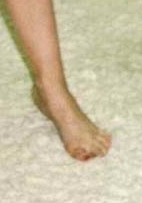
Issue #5: Laura doesn't like her ankles. She said on her show that her ankles are thick, that her calves go straight into her feet, or words to that effect. I can understand why this would bother her, because she works out every day and the rest of her body is tiny. So if the photos show thin, dainty ankles, they're probably someone else's. Check 'em out:
  

Issue #5: Great liars know they are lying, and do their best to (a) cover their tracks and (b) prepare for denial if they are caught. Laura covers both bases by (a) waiting until Bill Balance is dead to claim some of his photos were fake, and (b) writing "disgusting photos . . . were manufactured," and leaving out the source, so if someone calls her on it, she can point to an image from the internet like this one, which was altered, but to add the collar, not subtract her pants.


Or she can say, truthfully, that the original photos were manufactured. The process by which they were manufactured: Laura got naked, Bill pointed his camera at her, pressed the shutter and 7-11 developed the film [these were the good old days, folks]. 


In addition to implausibility, Laura provides us exhilarating hypocrisy on the side. If a female caller told her a similar story, she'd require hospitalization when she hung up. For dessert, we feast on Laura's unapologetic self-pity. People who are obsessed with loyalty and betrayal are a special breed. I've been lectured on this subject many times, and the lecturers had one thing in common: none of them benefitted me in any way commensurate to their demands for loyalty. These people were dead set on getting what they deserved, but they recognized no obligations to others. 

Now I promise you, neither Laura nor anyone handling her business is stupid. They anticipated these suspicions, but they had the chutzpah to put the book out anyway. They did it because they could, and their skill soars over me like the space shuttle. Onward to the stars, brave explorers!

Saturday, February 19, 2011

Morning Photos


This sculpture, titled Sister and Brother, was chiseled by an Italian-American sculptress named Denise DiSanto in 1984. We were a romantic item at that time, and I have carried these pieces with me ever since. They rule over my foggy, vine-covered back yard. Warm thoughts to Denise, wherever she is now.


Almost every morning, I ride my bike by the ocean. 


In winter, I sometimes get to see a full moon, descending into the sea.


These are the ruins of the Sutro Baths, where San Franciscans once played in the water.


On a holiday last month, I took my son Max on a train to Fremont, CA. Max doesn't care about the destination, as long as he's on a train.


Sunday, February 6, 2011

Heroes: Al Bowlly


For heroes, I pick the people I need. I admire people who overcame difficulties with style, especially if they had to reinvent themselves to fit their situation. The singer Al Bowlly did all this to an extent that was truly shocking.  When I first heard a recording of Al Bowlly singing, I pictured W. Somerset Maugham at the microphone. His burnished voice sounded intensely English to my ears. He also sounded very old, his voice concentrated like an aged cognac. Both of these impressions were false. 

Al Bowlly was born to Lebanese and Greek parents and he grew up in South Africa.  When he was young, he attempted to get started as a musician in the far east, and after several false starts and long day-to-day poverty, he made a strong career in England and American during the 1930s. During this period, English dance band singers did their best to sound American, because Jazz came from America. 

His singing invokes a world of elegance, where everyone dressed well, smoked incessantly and drank strong cocktails.


Al sang many songs that "do it" for me. Here are some more you can listen to, thanks to our friend YouTube: Blue Moon  Goodnight Sweetheart  Over the Rainbow  Au Revoir But Not Goodbye.  He came to America in the mid 1930s and achieved considerable success, but his career was up and down from start to finish.


In a tragic instance of bad timing, Bowlly and his wife returned to London just in time for the build-up to World War II. They separated shortly afterward. Al had problems with his throat, requiring surgery. He continued to perform, adapting himself to his opportunities.


In 1941, Bowlly died from the effects of a German bomb in London. A story is told that Al heard the air raid sirens, but told his neighbors he was sick of sleeping in the underground shelters. He intended to go to bed, read a book about cowboys and take his chances. I don't know if the story is true or not, but it would certainly be true to his character. He was forty-three years old. 


Sunday, January 30, 2011

Turning Point 1975


When I was 15 I lived in Western Kansas. It was a fascinating place, and I think of it often. During the Paleolithic period, this region was covered by an ocean. Standing on the flat plain, I can imagine a mile of salt water overhead, only now the ocean is a soaring sky. 


That vast, uncluttered space awakened my mind. My little town had a fine library and good public schools. The town was bounded on every side by farms. Farming requires an enormous mental effort, to be successful. After working on a farm, I will always respect the abilities of farmers. 


During a hot, silent summer, I walked to a grocery store and gas station and bought a paper-back book, Klingsor's Last Summer, by Herman Hesse. The story is about a painter named Klingsor who spends his summer painting in Italy, then dies unexpectedly in the fall. In Italy, Klingsor goes on a picnic with friends:

My friends, let’s not start becoming sensible so late in life.

What it all meant is: this day will never come again and anyone who fails to eat and drink and taste and smell it will never have it offered to him again in all eternity. The sun will never shine as it does today; it is in a constellation in the sky, a conjunction with Jupiter, with me, with Agosto and Ersilia and all of us, a conjunction that will never come again, not in a thousand years. And therefore I want to walk on your left side for a while, because that brings luck, and carry your emerald parasol—under its light my head will look like an opal. But you must play your part and sing a song, one of your best.

They climbed the narrow mountain path in the sun-splashed shadows of the chestnuts. When Klingsor looked up he saw before his face the slender calves of Martha, the artist, showing pink through her transparent stockings. If he looked back, the green of the parasol arched above Ersilia's curly black hair. Underneath she was silken violet, the only dark patch among all these figures. 

At a blue and orange farmhouse fallen summer apples lay in the meadow, cool and sour. They tasted them. Martha spoke enthusiastically about an outing on the Seine, in Paris, before the war. Ah yes, Paris, and the bliss of those days.

“That will never come again. Never again.”

“Nor ought it to,” the painter exclaimed vehemently, shaking his sparrow-hawk’s head fiercely. “Nothing ought to come again. Why should it? What childish wishes! The war has glossed over everything in the past, turning it all into a paradise, even the most idiotic things, the things we could well do without. Very well, it was lovely in Paris and lovely in Rome and lovely in Arles. But is it any less lovely today, right here? Paradise isn’t Paris and peacetime, Paradise is here. It lives up there on the mountain and in an hour we’ll be in the midst of it and will be he the thieves to whom it was said: This day you will be with me in Paradise.”


The idea that this present, temporary life was precious was a shock to me. I’d been brought up to think of this life as merely a prep school for the main event in Heaven. All human civilization would come crashing down. God would end the world in the giant, final Going Out of Business Sale. In the view of my people, this event and the supposed eternity following gave our lives meaning. 


Hesse's story pointed out a problem with this reasoning, which had been invisible to me. If this present life was meaningless without a Judgment and a future life in Heaven, what would we do in Heaven? If this life is meaningless without a future life, might not the future life suffer the same absence of meaning? Sooner or later, we'd be cornered. We might need to appreciate the life we had, the life we knew.

This love for the imperfect present got into me and grew. It didn’t overwhelm me, but it never stopped growing. Imperceptibly, I grew more grounded in this life on this earth.


The Non-Fiction Klingsor

Twenty-five years later, in December, 2000, I received a poster for an art show for my friend, artist Paul Stempen. I hadn't seen him in some time, so I phoned him at his house on Potrero Hill. Paul sounded giddy. He told me he'd gone to Italy the previous summer to paint with some art students from San Francisco. 


“It was the best time in my life,” he said. “We painted every day and drank every night. I didn’t have a care in the world. I met a girl there and fell in love with her. I just fell in love with her almost overnight.”


We exchanged friendly wishes for the new year and hung up. A few days later Paul died of a heart-attack. He was forty-three.


What it all meant is: this day will never come again and anyone who fails to eat and drink and taste and smell it will never have it offered to him again in all eternity.


Monday, January 24, 2011

Our Golden Age


Knowledge for the sake of knowledge had little attraction for the Athenians. They were realists. Knowledge was to be desired because it had value for living; it led men away from error to right action.
Edith Hamilton, The Greek Way

We tend to think of knowledge as good in itself, but knowledge is useful only when we can exploit it to help us reach our goals.
Marvin Minsky, The Society of Mind


We are fortunate to live in these times. No matter where we live, each of us can read high-quality information about almost any subject. Not just internet searches, but substantial books. Through eBooks you can carry every book you ever read around with you, for instant reference or—more likely—just the good feeling that it's there if you want it.


Many of us have great affection for physical library spaces, their church-like atmosphere with its incense aroma of paper, ink and glue. They are so pleasant, it's hard to recognize their limitations. Physical books take up space, and that space has to be sheltered, heated, lit and cleaned. People need to organize the books and track the borrowers. Add to that the costs of typesetting, binding, transporting and storing all those books before they were sold. Even for one book this cost is quite substantial over time.


In 1997 I found a book I wanted at my local library. Turning to the checkout record on the back page, I noticed the last checkout was in 1976. Yes, I have weird tastes, but that's not the point. The book had absorbed its share of the library's operating costs for twenty-one years, and the only thing we could say for sure about the benefit it offered was that it was available. Up to now, there was no point in thinking about saving these costs because it wasn't possible. Libraries were the only game in town.


eBooks are changing all that. The Amazon Kindle Store offers 800,000 titles you can get in a few seconds, and keep on their reader or a personal computer. [My beloved library houses 165,000 titles.] Some Kindle eBooks are free, most you have to pay for. Recently Amazon began its own eBook lending program, details on their site. Pricing of eBooks is becoming more regular, and few books cost more than $10. There are exceptions, but I think it's likely that the average price will settle below $10, due to competition. 


The next eBook I want will cost $7. The cheapest used copy will cost $5.50 with shipping and I'll have to wait a week for delivery. I'm impatient and I hate accumulating objects, so the extra $1.50 is worth it to me. It doesn't take me long to earn $7, so I'm inclined to buy this eBook even if I could get it from the library, to save time. 


I won't buy a Kindle Reader because I don't want two machines when I could have just one. For me the most elegant life has the fewest possessions. I'm happy for now with my white MacBook, but I dream of a smaller, 11-inch MacBook Air. It's the size and weight of a magazine. The storage memory in the Air is a flash drive with no moving parts. This makes it less prone to failure when moved around. I probably won't buy one this year; I'm waiting for the capacity to get larger in the 11-inch model. 


I think it is in the interest of the publishers to bring prices of eBooks down, for two reasons. First, it'll make purchasing an easy decision for readers even slightly interested. Second, it'll nearly eliminate free copying of texts, which is a publisher's big nightmare. Amazon has gone to great lengths to lock out all copying ability in its software, but this is not ultimately possible. Hackers claimed to have broken through the copyright protection one year ago, and no matter what Amazon rights, someone somewhere will successfully hack it. The way to minimize illegal copying is to make the product inexpensive, so it's easier to buy it than to steal it. 


The model for this happy relationship is iTunes. I bought the long playing record album above in 1973. At the time, I made my money by mowing neighbor's lawns. I had to work about 35 minutes to pay for each song on the album, then get my mom to drive me 46 miles to the nearest record store. 


Flash forward to today, iTunes will sell me a song for a couple minutes' work. I'll have it in a few seconds, and I don't have to buy the whole album. Just a few years ago, the recording industry nearly committed suicide over their anxiety about copying music. It was a real concern, because it's much easier to make high-quality copies of digital music than it was to make copies of LPs. Sony put anti-copying code in its CDs. They didn't see the larger picture: CDs are going out of existence anyway. 


Apple recognized the best solution to the problem: Make the music so inexpensive, it's easier for the average customer to buy it than to steal it. Whatever hack or recording I would do to get around paying, it's going to cost me more—in time—than the $0.99 Apple charges, so why do it? 


The other incredible deal available today is digital audiobooks. I buy mine from Audible.com. The audiobooks range higher in price than the eBooks, but you can get around that if you plan ahead. I listen to several hours of reading each week, so I buy credits in bulk from Audible, at a serious discount. This is the book I'm listening to now:


Christianity: The First Three Thousand Years by Diarmaid MacCulloch.

It's a long book, but I liked the sample and decided to download it. As it turns out, I receive an excellent entertainment value in this transaction. My price per hour of reading: 21 cents. 


Audiobooks put thousands of pages in my head that I wouldn't have time to read. In this banquet of delights, its important to think hard about how I plan to use the information. Happy reading to you all.