Saturday, June 23, 2012

Leaving Alcatraz


I'm beginning my sixth year of work on the same project, a long painting of the city of San Francisco. It took some time to find the right view to paint. I found it on the island of Alcatraz, near the summer solstice, in the evening. Only during this time of year does the north face of the city light up. 

Even though I live here, I conduct a long-distance romance with my subject. Since about 2009, I only see her one night a year. I feel like the young man in The Night Visiting Song, a traditional folksong from Scotland, sung here by Kate Rusby.


Walking around the crowds waiting to enter the prison, I climb the steep hill with my equipment, my knees protesting every step. When I stagger to the top, panting away, there she is, stretched out on the opposite shore. I say, "Hi, Honey. Did you have a good year? Just let me look at you. I do believe you're more beautiful tonight than the day we met." 


My time on the island is not comfortable. The weather is always cold. Gale force winds charge angrily through the Golden Gate. The name Alcatraz means "pelican" or "strange bird." In summer, clouds of sea birds use the rock for hatching babies, and as a giant toilet. Surely some of the prisoners did not deserve this level of smell and noise! The video below gives a sample of the atmosphere.


The light does not cooperate this time. The sun hides in clouds and fog, and only shines on the city for a few minutes. I reluctantly pack up to return on the early boat, instead of freezing in the dark. One last look. "Sorry, my Love. It has to end some day, and I'm afraid that day has arrived."


On my way back, a sunset breaks through the fog. 


Each minute, the colors in the sky burn brighter than the minute before. My heart races. "Where will it climax? Now? Or now? Or now? Has is already happened?" Edmund White wrote about being in love. It makes us aware of every passing minute, and how precious they are. 


The commotion of happiness ringing in my head was so loud I could scarcely hear what was happening. Such moments in a whole long life are neither as rare as one fears nor as frequent as one hopes.
—Edmund White, The Beautiful Room Is Empty


Tuesday, June 19, 2012

Packing Up


I hate my possessions and dream of living in empty rooms. Despite this desire, I accumulate stuff, like everyone else. No one forced these things on me. At some point, I thought my life required additional equipment. Just like everyone else, once I get something, I have a horrible time letting go of it. Somewhere in my art bin there are fine etching tools. I have not made an etching in thirty years. Thirty. Years. But I can't let go of the tools, because one day, long after I'm dead, in an alternate universe I'll never visit . . . I'll use them. No, I won't. I'll never use them, but I'm powerless to throw them out.


I make honest efforts to unburden myself from this stuff. I've given away books, furniture, appliances, and sculptures filled with glycerin. I received a few more inches of breathing room, but I was always disappointed with the result. I wanted to roller skate through the living room. 

The problem with trying to improve myself is that I only do what I'm forced to do. Many people succeed by putting themselves in uncomfortable situations, where they are forced to perform. They climb mountains or join the military.


In my case, I am moving out of my house. We're not out yet, but we soon will be. This deadline makes me ruthless, merciless in my hauling. I'd like to get my stuff down to one suitcase, but that's impossible. After two months of sorting, day and night, I'm down to a few cubic yards. Sadly, the house looks worse, because now there are boxes everywhere. I'm hoping to feel the open space when I get to the new house, but I may be in for more disappointment. 

Disappointment or not, it has to be done. Misa and Max have their own possessions to deal with, and we'll compare notes on the other side. 


Meanwhile, I feel relief already. I knew I had old light fixtures, cans of paint, photo negatives, slides vulnerable to molding. The constant reminders—Need to deal with those, maybe next weekend—took a toll on my meager mental processes. Now that stuff is all gone. I can put some new thoughts in those neurons.  

Saturday, May 26, 2012

The Last Day of School


Friday was Max's last day at Second Grade. He won't be attending the same school in the fall. He was sad to leave his teacher and his friends.


The children read poetry.


In the afternoon, it was time for the last goodbye.


Fortunately, there was still time for a soda with two pretty classmates, to unwind.


Long ago when I completed my second year of art school, all my classmates scattered for the summer. One girl left school permanently, to study in Paris. She wasn't a close friend of mine, but I still felt a paralyzing sadness, realizing I'd never see her again. It was a reminder that I couldn't control life. People and things would keep popping in and out of my life, regardless of my wishes. 


I always wanted security and permanence. I think everyone does, but we don't understand life when we do that. We don't want the whole situation to be permanent. When something good happens to us we want that part only to be permanent. We miss a critical point: The good part is good because it is not permanent. 


Good things come because we are in position to contact them, and open to them. It's like an eclipse. It happens because you are in motion, and another object is in motion. Their motions bring them into alignment, temporarily. I experienced this excitement many times; when I moved to a new place or fell in love with a new girl, and especially when I came to San Francisco. Each time, I opened myself to the new experience and let go of my past. That's what made it rewarding.  


It's only natural to hold on tight to those experiences, and wish they could never end, to just stay and live in those moments. But the motion that made the moments possible will inevitably move us further on. The only way to enjoy life is to open up to our new position, and give love to it as we let go of the old one. 


Ah, it’s an awful thing . . . and being young doesn’t help any . . . when you notice for the first time . . . the way you lose people as you go along . . . buddies you’ll never see again . . . never again . . . when you notice that they’ve disappeared like dreams . . . that it’s all over . . . finished . . . that you too will get lost someday . . . a long way off but inevitably . . . in the awful torrent of things and people . . . of the days and shapes . . . that pass . . . that never stop . . . All these pests . . . all these bystanders and extras strolling under the arcades, with their pince-nez, their umbrellas, and their little mutts on the leash . . . you’ll never see them again . . . Already they’re passing . . . they’re in a dream with the others . . . they’re in cahoots . . . soon they’ll be gone . . . It’s really sad . . . it’s rotten . . . all these harmless people parading along the shop fronts . . . A wild desire took hold of me . . . I was trembling with panic . . . I wanted to jump out on them . . . to plant myself in front of them . . . and make them stop where they were . . . Grab them by their coats . . . a dumb idea . . . and make them stop . . . and not move anymore . . . stay where they were, once and for all . . . and not see them going away anymore.   —Louis-Ferdinand Celine, Death on the Installment Plan


Sunday, April 8, 2012

Southern California Beach Train 2012


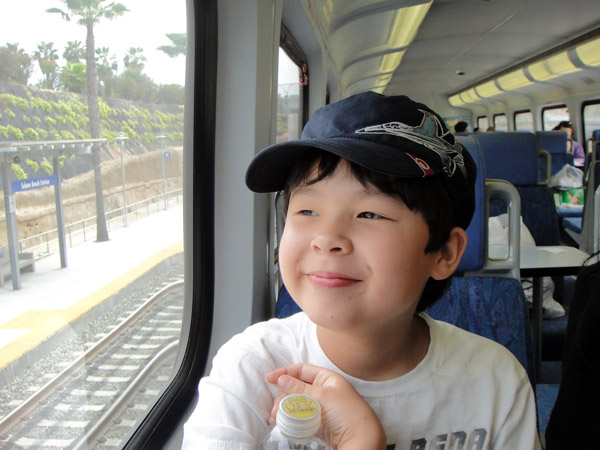
Last week we rode the Coaster Train between San Diego and Oceanside, CA. It's one of Max's and my favorite excursions. I made a short movie of our first trip in 2009. To begin with, the train is painted my favorite color, and very few vehicles are. The seats are comfortable. You can sit high up and eat at a little table as you ride. 

We passed lagoons, dunes and beach towns. From the Coaster Train, it's a beautiful world, and everyone is doing okay. In some sense, there's nothing going on out there, but it's wonderfully relaxing to watch, as it drifts past.