Saturday, May 26, 2012

The Last Day of School


Friday was Max's last day at Second Grade. He won't be attending the same school in the fall. He was sad to leave his teacher and his friends.


The children read poetry.


In the afternoon, it was time for the last goodbye.


Fortunately, there was still time for a soda with two pretty classmates, to unwind.


Long ago when I completed my second year of art school, all my classmates scattered for the summer. One girl left school permanently, to study in Paris. She wasn't a close friend of mine, but I still felt a paralyzing sadness, realizing I'd never see her again. It was a reminder that I couldn't control life. People and things would keep popping in and out of my life, regardless of my wishes. 


I always wanted security and permanence. I think everyone does, but we don't understand life when we do that. We don't want the whole situation to be permanent. When something good happens to us we want that part only to be permanent. We miss a critical point: The good part is good because it is not permanent. 


Good things come because we are in position to contact them, and open to them. It's like an eclipse. It happens because you are in motion, and another object is in motion. Their motions bring them into alignment, temporarily. I experienced this excitement many times; when I moved to a new place or fell in love with a new girl, and especially when I came to San Francisco. Each time, I opened myself to the new experience and let go of my past. That's what made it rewarding.  


It's only natural to hold on tight to those experiences, and wish they could never end, to just stay and live in those moments. But the motion that made the moments possible will inevitably move us further on. The only way to enjoy life is to open up to our new position, and give love to it as we let go of the old one. 


Ah, it’s an awful thing . . . and being young doesn’t help any . . . when you notice for the first time . . . the way you lose people as you go along . . . buddies you’ll never see again . . . never again . . . when you notice that they’ve disappeared like dreams . . . that it’s all over . . . finished . . . that you too will get lost someday . . . a long way off but inevitably . . . in the awful torrent of things and people . . . of the days and shapes . . . that pass . . . that never stop . . . All these pests . . . all these bystanders and extras strolling under the arcades, with their pince-nez, their umbrellas, and their little mutts on the leash . . . you’ll never see them again . . . Already they’re passing . . . they’re in a dream with the others . . . they’re in cahoots . . . soon they’ll be gone . . . It’s really sad . . . it’s rotten . . . all these harmless people parading along the shop fronts . . . A wild desire took hold of me . . . I was trembling with panic . . . I wanted to jump out on them . . . to plant myself in front of them . . . and make them stop where they were . . . Grab them by their coats . . . a dumb idea . . . and make them stop . . . and not move anymore . . . stay where they were, once and for all . . . and not see them going away anymore.   —Louis-Ferdinand Celine, Death on the Installment Plan


Sunday, April 8, 2012

Southern California Beach Train 2012


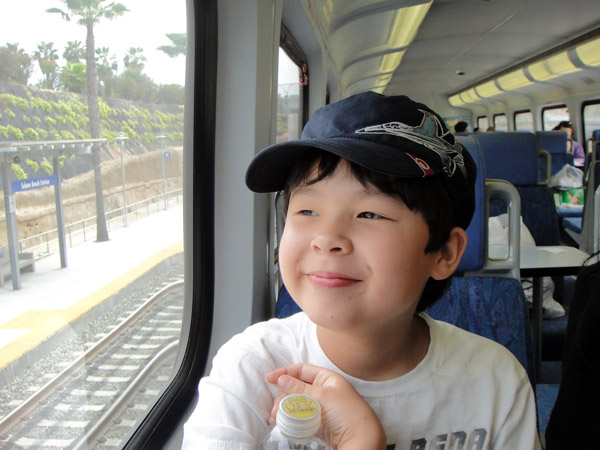
Last week we rode the Coaster Train between San Diego and Oceanside, CA. It's one of Max's and my favorite excursions. I made a short movie of our first trip in 2009. To begin with, the train is painted my favorite color, and very few vehicles are. The seats are comfortable. You can sit high up and eat at a little table as you ride. 

We passed lagoons, dunes and beach towns. From the Coaster Train, it's a beautiful world, and everyone is doing okay. In some sense, there's nothing going on out there, but it's wonderfully relaxing to watch, as it drifts past. 


Sunday, February 5, 2012

Max, Basketball, and the End of Our World

Basketball


The day Max was born, I began dreading the inevitable re-involvement with sports. I hate sports. My last competition was a picnic softball game in 1982. I slid into home plate, ripped a knee out of my one pair of blue jeans, and called it a career. No one regretted my departure. In the years that followed, sports receded further from my consciousness, until they looked like rituals from another planet. Misa was no more enthusiastic or adept than I was.

Despite this heredity, Max wants to play basketball. Misa and I are all in favor, because it gets him working together with other kids. I took him out to practice. It did not go well. I yelled at him continually to play ball, and he collapsed in frustration. 


Then came the first game. We got to be sports parents, exploding with anxiety, yelling our lungs out. Max got off to a slow start, but he ran down court with his team and retrieved a rebound or two. When the other guys passed to him, he did his best to dribble, then pass the ball on. Two thirds of the way through the game—Providence must have intervened—he sunk a basket! 


When the game was over, Max's face shone red as a Christmas bulb. Another mommy introduced herself. Her son was an unusually tall boy, and she complimented Max's playing. "Remember," she said, "tall kids have a much harder time controlling their arms and legs." She was correct, of course, and I was duly chastened; maybe I'd been too critical of Max. 


The End of Our World


Recently, at the end of our day, I watched a few minutes of a science program with Max. The subject was supernovas. When I put him to bed, Max asked me to stay at his bedside. He predicted he'd have nightmares, for fear our sun will blow up. We talked for a long time, as I stroked his head. I reminded him that Misa and I always told him the truth, instead of filling his head with Santa Claus and the Tooth Fairy. 


I'd read that exploding stars produced the calcium in our bones, and the iron in our blood. We were not separate from this violence; we were a part of it. Finally, the event would almost certainly occur four billion years from now, when all trace of our species has vanished. I said, "You won't be there, so there's nothing to give you a nightmare." 


"If you want a nightmare, try the Book of Revelation. My Mommy and Daddy told me an angry god was coming to earth, to separate good people from bad people, rain down plagues and ultimately destroy the planet. Instead of billions of years away, they told me this would happen soon. When I was twelve years old, a friend of my Dad told me The Second Coming would probably happen before I turned fourteen."


"THAT is a nightmare, but there's no evidence to support it, so you can forget it all. I predict you won't have any nightmares tonight." I live for moments like this with my son. No one else can do this job. 


In the morning, my existence was validated, no nightmare.


Wednesday, January 18, 2012

Escape From Tactical Hell


[looking at the Grand Canyon, you learn] The most important lesson of Darwinism: Weak forces, operating over long periods of time, create large and dramatic change.
—Jerry Coyne, Why Evolution Is True

When frustrated, I often think I need a different attitude or more energy in pursuing my goals. This is a mistake. What yields results for me is endurance, planning for the long term. This best course of action is also the most difficult. It's far too easy, too human, to be distracted by the present irritations.  Television and the internet feed this short, nervous attention span by setting off emotional firecrackers, describing every momentary event as a cataclysm. Our instinct for self-preservation keeps us glued to the screen, while summer passes away and we get old.  


In contrast, consider this story: Directly after Japan's catastrophic defeat in World War II, a group of business executives met to plan the future of their company. John W. Dower  in his book, Embracing Defeat, records their approach: We must make a one hundred year plan, and not be disturbed by the difficulties of the moment.  On that basis, these leaders built up a ruined land into the second largest economy on earth.


Wired Magazine published a wonderful article in their December, 2001 issue on Jeff Bezos of Amazon.  He says:

Our first shareholder letter, in 1997, was entitled, “It’s all about the long term.” If everything you do needs to work on a three-year time horizon, then you’re competing against a lot of people. But if you’re willing to invest on a seven-year time horizon, you’re now competing against a fraction of those people, because very few companies are willing to do that. Just by lengthening the time horizon, you can engage in endeavors that you could never otherwise pursue. . . . In some cases, things are inevitable. The hard part is that you don’t know how long it might take, but you know it will happen if you’re patient enough. Ebooks had to happen. Infrastructure web services had to happen. So you can do these things with conviction if you are long-term-oriented and patient.


My hero, Robert Greene expounds further on this topic:


According to the cosmology of the ancient Greeks, the gods were thought to have complete vision into the future. They saw everything to come, right down to the intricate details. Men, on the other hand, were seen as victims of fate, trapped in the moment and their emotions, unable to see beyond immediate dangers. Those heroes, such as Odysseus, who were able to look beyond the present and plan several steps ahead, seemed to defy fate, to approximate the gods in their ability to determine the future. The comparison is still valid—those among us who think further ahead and patiently bring their plans to fruition seem to have a godlike power. 


Because most people are too imprisoned in the moment to plan with this kind of foresight, the ability to ignore immediate dangers and pleasures translates into power. It is the power of being able to overcome the natural human tendency to react to things as they happen, and instead to train oneself to step back, imagining the larger things taking shape beyond one’s immediate vision. Most people believe that they are in fact aware of the future, that they are planning and thinking ahead. They are usually deluded: What they are really doing is succumbing to their desires, to what they want the future to be. Their plans are vague, on their imaginations rather than their reality. They may believe they are thinking all the way to the end, but they are really only focusing on the happy ending, and deluding themselves by the strength of their desire. —The 48 Laws of Power


Long term planning is no more natural for me than for anyone else. Fortunately, circumstances force me to stretch my timeline, almost every day. I'm working on two projects that have been going for more than four years. I'm also helping to raise a child, an effort that has no identifiable endpoint. Take heart, fellow travelers. Keep to your path.