Saturday, June 18, 2011

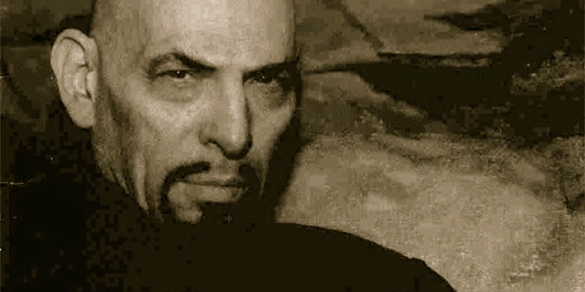
My Neighbor, The Vicar of Satan


One night in 1993, I walked out of my Richmond District apartment and went to the nearest grocery store. Scanning the shelves of canned vegetables, my head swung to the right. My eyes rested on the bald head of an older man. A warmth came over me; my father was bald, so older bald men reminded me of him. In a couple of seconds, I realized that this wasn’t just any old bald guy. I was standing next to Anton LaVey, founder of The Church of Satan. 

We didn’t talk, but I stood in line behind LaVey and his girlfriend, Blanche Barton. Anton ducked out of line to get ice cream as Blanche approached the register. They both looked happy, and LaVey’s face was most unusual; scary and charming at once. That’s what I love about San Francisco: you can walk out for lima beans and run into the Anti-Christ.

Later I read several books by, and about, Anton LaVey. I’d heard of him while growing up in the late 1960s. The Church of Satan was hot news back then. Many magazine covers and TV news stories flashed LaVey’s face toward a terrified public. Most of my information came from Christian alarmists, for whom his Church of Satan was literally a god-send, the fulfillment of their dire warnings. My father was a Christian minister, and the polarity of his influence—mirroring this other bald man who lived down the street—startled and intrigued me.


LaVey’s writing was a mixed bag. Some of it read like a joke, and at times the joke wore thin. But his underlying philosophy was down-to-earth, even conservative. He said the point of the Church of Satan was to break up dull intellectual conformity. If he’d begun the Church later, he would have organized it around patriotism and traditional values, because they became intellectually out of fashion. He warned his readers to avoid watching television, as this would make them as stupid as the victims they wanted to dominate. LaVey presented these thoughts with a good-natured wink, but he also produced flashes of brilliance, especially in his book of essays, The Devil’s Notebook.

About music, LaVey said the value of hearing a piece is the feelings and memories we associate with it. It’s often more powerful to listen to music from other times or countries, because you can control what you associate with it. If you listen to what’s hot on the radio, the associations are either random, or forced on you by the medium. 

He also wrote about loving this life, with all its limitations:

People don’t realize how long forever is when they say they want to live forever. All the settings would blend together — the emotions would remain strong but the individual scene wouldn’t stand out in your memory. There would be so much blending and melding in your past. Better to live a shorter time and let each instance, each setting stand out in your mind as strong as the emotions themselves.

These quiet, poetic thoughts, and LaVey’s physical impression stood in stark contrast to his reputation. According to news stories, he had legions of followers, who kept him in vast luxury. He lived in a famous “Black House,” filled with secret passage ways. He employed a chauffeur and a fleet of classic cars. His Church of Satan was an active, powerful organization, plotting to rule the world. 

LaVey’s skill at telling these lies was matched by amazingly gullible journalists. No one seems to have fact-checked a story about him during his lifetime. His own writing about himself approached the preposterous. I don’t know how anyone could sit across the interview table from Anton LaVey and believe he was wealthy, when one glance at his teeth would inspire doubt. 

Just before Anton LaVey died in 1997, I met author and publisher Jack Boulware at a bar in North Beach. I’d read Jack’s article on LaVey in his offbeat magazine, The Nose. I said to him, “What I want to know is this: How does Anton LaVey make a living? He’s eating and paying property taxes somehow. Is he another San Francisco nutcase, with no visible means of support?” Jack said he couldn’t figure it out either, but he thought some rich widows in Pacific Heights paid LaVey to place hexes on their enemies. After LaVey’s death, Jack discovered that he’d made almost no money in his life. He got by with the help of welfare, but he’d let his house deteriorate to a near crumbling state. 

Anton LaVey’s distaste for working appears to have driven all his creative efforts, including his legendary persona, Satan’s Press Secretary. This revelation makes me sad, because I think he had unusual talent, and could have done well for himself. I wonder how many cults begin with one person’s desire to live without working. 


Anton’s Nemesis: The Anti-Anti-Christ
You may think Anton LaVey was a skillful con-man, benefitting from people’s fear and ignorance. Con-games are endlessly fascinating. At any point, they can be taken over or turned around. The competition is watching, and they don’t miss a trick.


In 1973, a young author in Southern California named Mike Warnke released his first book, The Satan Seller, an account of his life as a “Satanic High Priest,” and his subsequent conversion to Christianity. In many ways, Warnke’s story was more spectacular than LaVey’s. During his career as a Satanist, Warnke claimed to have ruled over a “coven” of 1,500 members, and presided over bizarre, horrifying ceremonies. These included animal sacrifices, one rape, and eating a human finger, severed from one of his followers. To cap it all, Warnke’s stories dripped with the ecstasy of the repentant sinner: “Look at my wretched, disgusting sins! I can’t believe how evil I was!” Who could resist?

I read The Satan Seller at age 14 and ate it up. Parts of the book should have aroused suspicion in Christian adults, however. His public speaking events were even more suspect. During his tour of duty in Vietnam, Warnke claimed he was wounded by an arrow, presumably flung at him by a Vietcong archer. In fact, almost every line of Warnke’s book was a lie, but he would not be exposed to the Christian public for almost twenty years. During the 1970s, no one questioned his account. He was talking about the Devil, after all, to people who believed in the Devil. His readers couldn’t say, “Well, Satan is real, but this finger-eating stuff is implausible.” 

The book rocketed Warnke to instant celebrity in Christian churches. His book flew off the shelves and he had his pick of speaking engagements and television interviews. 

The irony approached perfection: Anton LaVey performed his seedy, carnival-side-show rituals for a few dozen people in his tiny house. He gave himself a biography that’s greatly inflated, but he admitted Satan did not exist, and that he was mainly having fun with the character of the Devil.

Mike grew his hair into a mullet to end all mullets

Then—then!—comes Mike Warnke, who never worshipped Satan, confessing to atrocities LaVey never dreamed of, and selling his story to Christians who wanted to shoot Anton LaVey on sight! Warnke told his readers Satan was real, alright! Satan was coming in the window to get them. 

And here’s the kicker, because this story only gets better—while Anton LaVey died a pauper, Mike Warnke made millions with his lies, verified by his tax returns. Today his operation is smaller than it once was, but Mike Warnke is still telling his story to anyone who’ll listen. And contribute.

Sunday, June 12, 2011

Dating and Learning


Single life didn't thrill me, generally. For better and for worse, I am made for marriage. When I was single, I joined an internet dating site. A female friend told me about the site, and I'm grateful to her for all the experiences I had, meeting women I'd never encounter independently. I had the good sense to interview female friends who used the site, and find out what they liked to see in the male profiles. I tailored my own profile to their comments, and I was off to the races. 


I received good results. I could go out and meet a new girl several times a week, if I wanted. These first dates were like job interviews. Going through many of them, I gained broader knowledge of the general female population [I needed this]. I also learned to set up rules for sorting people out. 

Volume was crucial to help me learn. Meeting an attractive woman paralyzed my brain. The only way to calm down was to do it over and over again, until my nerves got tired of reacting and I could observe the process dispassionately. I had the same experience on actual job interviews. I once looked for a new job for two full years. During the last phase of my search, I gave up hoping for a job. My mission was to get interviewed as many times as I could. After Interview sixty-three, my nerves finally exhausted themselves and I could face the interviewer calmly. Soon after, I had two job offers, so I set up a good friend with the second.

Now I belong to an internet site that connects baby-sitters with parents who want to hire them. The  baby-sitting site is surprisingly similar to the dating site. The same rules apply, so I get to practice them all over again. Here's what I've learned.

1. Make rules. Write them down. 
Sorting requires distinctions. Looking for the good in everyone obscures this requirement. All rules will look narrow-minded or arbitrary, and that's just a characteristic of rules. Make them. Apply them. In dating, I would never respond to a woman who listed "Women's Studies" as her major in college. No discussion; never reply. On the positive side, close locations got priority, since I didn't own a car at that time. With the baby-sitters, anyone who has a problem producing identification doesn't get contacted again. I am surprised at how many young people claim their driver's license got stolen. Someone needs to report on this crime wave.

2. Invite all who qualify.
For eight years, I lived in a tiny apartment in an old building on Nob Hill. I had no view. Despite these disadvantages, I held a party every year and fifty people—and more—would cram into my little box. I learned to produce this result by counting on no one person to show up. In this instance, my criteria were much wider than for girlfriends or baby-sitters. Anyone who might add to the mix was welcome, as were their friends, relatives, acquaintances. I aimed to invite about two hundred people, knowing about a quarter would come. I invited everyone in my urban universe, not just the friends I already had: waiters, postal carriers, my laundress, barber, doctor, boss, tax accountant, dance teacher, the cute cashier at my grocery. With the baby-sitters, I send replies for a job to a handful of people at once, and usually hear from just one who can be counted on to show up the first time. 


3. Clarity and consistency are crucial. It doesn't matter at all if you're "right."
Was it fair of me to disqualify the Women's Studies majors? I could say "Yes!" but that's beside the point. You must sort. Any rule is better than no rule. I didn't start out this way. Bitter experience nailed it into my skull. Women's studies and missing driver's licenses were often—make that "always"—the tell-tale signs of worse problems, which I explored at my peril. 


3. Never ask why. 
Actions = everything. 
Words = nothing. 
Reasons = less than nothing. 
It doesn't matter why people do things, only that they do them. You should expect them to always act the same way. This is by far the safest bet. When I approach new people with this attitude, I'm comforted by how much they reveal about themselves. If they are paying attention, they'll also know about me. The character of our entire relationship - personal or professional - is delivered in the first five minutes. All we need to do is pay attention to it, and we'll know exactly what to expect from each other. The girl who gets blind drunk on the first date isn't having an "off day." She isn't nervous because I'm so magnetic. She simply has a drinking problem. She will achieve a similar state every time we go out. The sitter who arrives 40 minutes late will always arrive late. Of course the positive actions endure also. The sitter who's on time the first day will rarely disappoint.


4. Move on. 
On the dating site, there was an unwritten rule we all learned. If you're not interested in a person for any reason, just stop responding to them. Silence is the best way to communicate that someone is off your list, and the best way to know that you've been crossed off someone else's. No explanation, no excuses, no accusations, no tantrums. Just never reply to their email again. 

I find these principles helpful in many situations, not just dating or getting help. Whenever I depart from them, I always regret it. When I follow them, good almost always results. Good luck, single people. Good luck, job seekers. Good luck, parents.

Monday, June 6, 2011

Heroes: Robert Greene


Robert Greene [left] with rapper and entrepreneur Curtis Jackson, stage name 50 Cent
 It is to him who understands the world—not to those who disfigure it—that we owe our reverence. —Voltaire

Conflict is a constant irritation in life. We feel conflict between our ideas and what actually happens, conflict between what we want and our abilities, and of course conflict with our enemies. I prefer to avoid confrontation, and I dream of a position that would protect me from all conflict. This does not appear to exist, however. In fact, the more success I have achieved, the more conflict has entered my life. I did not prepare well for conflict, growing up. No one told me when and how to fight. If fighting is not advantageous, what exactly to do? These questions influenced my most important needs and wants: making a living and attracting women—seduction being a form of conflict. Now I have a family, and I could describe every minute of my day as a battle. 

Four years ago I discovered the writing of Robert Greene by accident. At the time, I was caught in a fight. There was no negotiating around the problem or convincing the enemy to retreat with niceness. I was outnumbered, and several people close to me said I had no hope, yet I knew I had to win. Intrigued by one of Greene's interviews, I bought a copy of his book, The 33 Strategies of War. 

Through extensive planning, indirect maneuvers and controlling my information, I won. As you might imagine, this outcome confirmed the value I found in the book. I devoured Robert Greene's other books, The 48 Laws of Power, The Art of Seduction and The 50th Law. I read them through four times and explored many books in their bibliographies. I typed hundreds of pages of notes. I will probably read them through again. Greene patterns his work on Niccolo Machiavelli's. Both authors looked to history to obtain their strategies for success. History is the next best thing to a laboratory experiment, when we study Greene's favorite subjects, Power, Seduction and War.

I offer some favorite quotes from the books below.


Law 40
Despise the Free Lunch
What is offered for free is dangerous – it usually involves either a trick or a hidden obligation.  What has worth is worth paying for.  By paying your own way you stay clear of gratitude, guilt, and deceit.  It is also often wise to pay the full price – there is no cutting corners with excellence.  Be lavish with your money and keep it circulating, for generosity is a sign and a magnet for power.
Understand: With one exception — death — no lasting change in fortune comes quickly. Sudden wealth rarely lasts, for its is built on nothing solid. Never let lust for money lure you out of the protective and enduring fortress of real power. Make power your goal and money will find its way to you. 


Law 29
Plan All the Way to the End
The ending is everything.  Plan all the way to it, taking into account all the possible consequences, obstacles, and twists of fortune that might reverse your hard work and give the glory to others.  By planning to the end you will not be overwhelmed by circumstances and you will know when to stop.  Gently guide fortune and help determine the future by thinking far ahead.
Most men are ruled by the heart, not the head. Their plans are vague, and when they meet obstacles they improvise. But improvisation will only bring you as far as the next crisis, and is never a substitute for thinking several steps ahead and planning to the end.
What good is it to have the greatest dream in the world if others reap 
the benefits and the glory? Never lose your head over a vague, open
ended dream-plan to the end. 

There is a simple reason why most men never know when to come off the attack: they form no concrete idea of their goal. Once they achieve victory they only hunger for more. To stop — to aim for a goal and then keep to it — seems almost inhuman, in fact; yet nothing is more critical to the maintenance of power. The person who goes too far in his triumphs creates a reaction that inevitably leads to a decline. The only solution is to plan for the long run. Foresee the future with as much clarity as the gods on Mount Olympus, who look through the clouds and see the ends of all things.


Remember: it is the form that matters, not the content. The less your targets focus on what you say, and the more on how it makes them feel, the more seductive your effect. Give your words a lofty, spiritual, literary flavor the better to insinuate desire in your unwitting victims. 

If no resistances or obstacles face you, you must create them. No seduction can proceed without them. 


Eva Peron’s voice could make audiences weep; because of this, people saw in her great charisma. She never forgot the experience. Her every public act was framed in dramatic and religious motifs. Drama is condensed emotion, and the Catholic religion is a force that reaches into your childhood, hits you where you cannot help yourself. Evita’s uplifted arms, her staged acts of charity, her sacrifices for the common folk—all this went straight to the heart. It was not her goodness alone that was charismatic, although the appearance of goodness is alluring enough. It was her ability to dramatize her goodness. 


To promote any value, even peace and pacifism, you must be willing to fight for it and to aim at results—not simply the good, warm feeling that expressing such ideas might bring you. The moment you aim for results, you are in the realm of strategy. War and strategy have an inexorable logic: if you want or desire anything, you must be ready and able to fight for it.

Judge people by their actions. The brilliance of warfare is that no amount of eloquence or talk can explain away a failure on the battlefield. A general has led his troops to defeat, lives have been wasted, and that is how history will judge him. You must strive to apply this ruthless standard in your daily life, judging people by the results of their actions, the deeds that can be seen and measured, the maneuvers they have used to gain power. What people say about themselves does not matter; people will say anything. Look at what they have done; deeds do not lie. You must also apply this logic to yourself. In looking back at a defeat, you must identify the things you could have done differently. It is your own bad strategies, not the unfair opponent, that are to blame for your failures. You are responsible for the good and bad in your life. As a corollary to this, look at everything other people do as a strategic maneuver, an attempt to gain victory. People who accuse you of being unfair for example, who try to make you feel guilty, who talk about justice and morality, are trying to gain an advantage on the chessboard. — Robert Greene 

Sunday, May 29, 2011

In Memory of Those Who Served

Memorial Day is set aside to honor people who died fighting in America's wars. So far as I know, no one in my family died while in the service, but several men served in the armed forces, so I honor them today also. The most distant relative I know about was my great-great grandfather John W. Welborn. He fought in the Union Army from November, 1861 to December, 1864. His war diary for July, 1864 describes a campaign to take Atlanta, Georgia in stark terms:


July 19th 3 miles, with some skirmishing, and took Decatur. 10th came upon the Rebs’ lines, enclosing Atlanta. 
From the 19th to 22nd heavy skirmishing and cannonading. 
From 22 to 27th we was fortifying, and part of the time under brisk shelling. 28th heavy fighting on our right; 10,000 Rebs’ loss, ours 2000. 


The young man seated is my grandfather, John Calvin Turnage, in 1918. John Calvin Turnage served his country in WW I. He was in the 138th. Field Artillery Regiment of the Old Kentucky National Guard. He served with the American Expeditionary Force in France in 1918. Although he did not see combat, his unit was moving up to the front when the Armistice was signed, and only a train-wreck kept him from seeing action at the Front. 


John Calvin's son, my father, Bill Turnage served in the Army Air Corps during World War II. HIs fondest ambition was to become a fighter pilot. He did well in pilot's training, but was removed when a heart condition disqualified him. He attempted to go overseas as a radio operator, but the war ended before he could depart. He was shaped by his time in the service, and he remembered it in great detail ever after. He kept a war diary, just as his great grandfather Welborn had. Near his twentieth birthday and far from home, he wrote:

I received a letter from Betty two days ago. She told me that she had never loved me and that she had found someone else. They should be married by now. I shall never love another girl. 

The young man did live to love again. I wonder how many service men received the dreaded letter from their sweetheart at home.


I'm sure those of us who have not experienced the horror of war cannot imagine it. "Oh, your train wrecked on the way to the front, Soldier? You're the lucky one."

We hope for a peaceful world, where young men or women will not die from bullets or bombs. I don't know how to accomplish this, or even how we could measure progress. I can say we seem to know each other better than we once did. Bill's president declared war on the Empire of Japan, but his son married a Japanese girl. During World War I the Russian Revolution took place. Almost one hundred years later, John Calvin Turnage's half-Asian great-grandson is best friends with a little girl whose parents came to America from the former Soviet Republic of Moldova. Let's hope love can conquer all.


I close with a beautiful song by Eric Bogle, sung by June Tabor. It needs no further introduction. Hail to all our heroes, past and present. Thank you for your bravery and your service.


No Man's Land, by Eric Bogle

1. Well, how do you do, Private William McBride,
Do you mind if I sit down here by your graveside?
And rest for awhile in the warm summer sun,
I've been walking all day, and I'm nearly done.
And I see by your gravestone you were only 19
When you joined the glorious fallen in 1916,
Well, I hope you died quick and I hope you died clean
Or, Willie McBride, was it slow and obscene?

cho: Did they Beat the drum slowly, did the play the pipes lowly?
Did the rifles fir o'er you as they lowered you down?
Did the bugles sound The Last Post in chorus?
Did the pipes play the Flowers of the Forest?

And did you leave a wife or a sweetheart behind
In some loyal heart is your memory enshrined?
And, though you died back in 1916,
To that loyal heart are you always 19?
Or are you a stranger without even a name,
Forever enshrined behind some glass pane,
In an old photograph, torn and tattered and stained,
And fading to yellow in a brown leather frame?

3. The sun's shining down on these green fields of France;
The warm wind blows gently, and the red poppies dance.
The trenches have vanished long under the plow;
No gas and no barbed wire, no guns firing now.
But here in this graveyard that's still No Man's Land
The countless white crosses in mute witness stand
To man's blind indifference to his fellow man.
And a whole generation who were butchered and damned.

4. And I can't help but wonder, no Willie McBride,
Do all those who lie here know why they died?
Did you really believe them when they told you 'The Cause?'
Did you really believe that this war would end wars?
Well the suffering, the sorrow, the glory, the shame
The killing, the dying, it was all done in vain,
For Willie McBride, it all happened again,
And again, and again, and again, and again.


Sunday, May 15, 2011

Tell A Good Story


It's hard to let go of bad ideas. We'd like to see our intuitions proved correct, so we never had to learn anything. Real education, however, contradicts and destroys our mistaken intuitions. One of my mistakes involves work and rewards. I hope to be rewarded for my abilities, to do a good job and people will notice. This is not how the world works. Rewards are not based on objective qualities in the work, but in other people's perceptions. Wise workers carefully control those perceptions. Rewards come to those who tell a good story. 


We may regard "honesty" as a virtue, but it's often an excuse for our failure at public relations. Any situation or event may be described accurately in several ways, with dramatically different effects. In his book, Flaubert's Parrot, author Julian Barnes presents contrasting sketches of the french author's life. Here's one example of his treatments: 

1880
Full of honour, widely loved, and still working hard to the end, Gustave Flaubert dies at Croisset. 

1880
Impoverished, lonely and exhausted, Gustave Flaubert dies. Zola, in his obituary notice, comments that he was unknown to four-fifths of Rouen, and detested by the other fifth. 

So far as I know, the statements are equally honest. Life is complex, never just one way.


Once I worked for a man who was famous in his field. Seen up close, his work was a disaster. All his projects were completed late, if at all. Every aspect of his business was unprofitable and out of control. What he did control, masterfully, were his press releases. Each one was an ecstatic hymn to his greatness, citing all his awards and his position at the vanguard of his profession. Important clients trampled each other to retain his services. 


In some jobs, like law and acting, story-telling is 100% of the game. But even in a field like art, what is said is much more important than paint on canvas. Consider the work of modernist painter Barnet Newman, who painted the same picture hundreds of times, and got himself into all the art history books.


Despite his personal charm and verbal brilliance, Barnet Newman’s art remained baffling even to insiders. But what he said about it sounded so deep, and the way he said it was so forceful that he gradually won over the most influential writers on contemporary art. —Alice Goldfarb Marquis, The Art Biz


Internal perception is just as powerful as the external kind. Carefully prepare what you say to yourself about what you're doing. We have an unfortunate tendency to equate truth with negativity. If you are too "honest" with yourself you'll easily to become your own worst enemy. To interrupt this pattern, I sat down a few years ago and wrote down everything I could remember doing right. It took some time to get good at remembering. In trying to maximize good outcomes, I often forget that things could always turn out worse. When I get discouraged, I force myself to read the stuff I did right and add to it from time to time. 


Tuesday, May 3, 2011

I know, I know . . .


Hello everyone. The blog has been lean and may remain so for now. I have many thoughts to put down, but not enough time to put them in presentable form. You deserve a planned presentation; I don't want to just spew out stream of consciousness rants. 


So lately that production process hasn't happened. This post is to let you know I'm still writing, but tied up in other areas. Blogging is somewhere around Number 7 in my job responsibilities. Right now Jobs 1-6 are rather heavy, but no complaints. Meanwhile my son Max built a robot to help Mommy vacuum the house. 


Congratulations to all people of good will on the death of Osama bin Laden. Happy spring days to you, and watch this space for more posts eventually.